
COPPER TERMINALS
Introduction

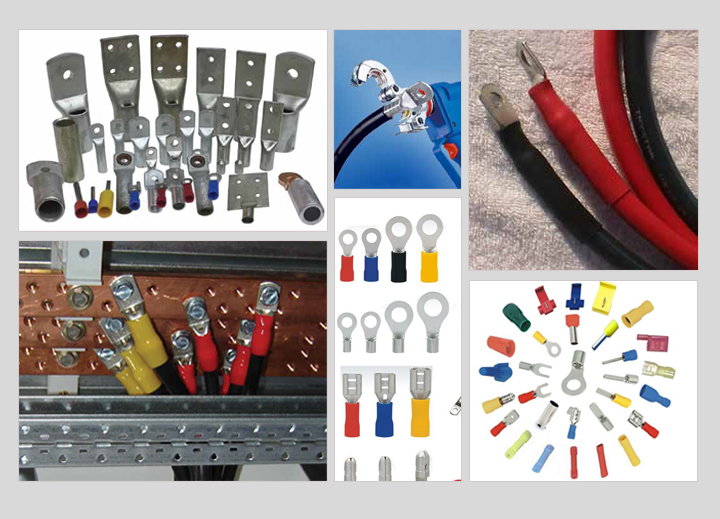 Cable lugs are devices used for connecting cables to electrical appliances, other cables, surfaces, or mechanisms. The clamps that
connect wires to an automotive battery are a common example of a cable lug, as are the ends of battery jumper cables designed to
be easily installed and removed for repairs or maintenance, Cable lugs are generally used when permanent, direct-fastening methods
are not feasible or necessary.
The words “cable” and “wire” are sometimes mistakenly interchanged. Cables are made from multiple wire strands, while wires consist
of a single strand. Both cables and wires may be used with cable lugs of a suitable type.
One end of a cable lug is typically used for connecting a cable, which could be soldered, welded, or crimped depending on the type. The
connection end of the lug is then fastened to a matching terminal or connection point by means of a bolt, screw, or spring clip. Numerous
sizes, configurations, and material types typically are available to suit particular applications, but metal is the predominate material
used. A cable lug is sometimes called a “cable connector” or “cable anchor,” depending on industry and application.
The connector end of a cable lug is typically chosen for its compatibility to the terminal type or anchoring method. Fork or U-shaped lugs
are used for screw terminals; closed-ring or O-type lugs are used for bolt-on applications; and pin or spade lugs are used for press-on
pin or blade terminals. A cable lug also serves as a cable-size reducer, thereby allowing thick cables to be attached to a connector with
a smaller diameter.
Although cable lugs are widely used for electrical connections, more robust versions are used to anchor non-electrical cables to
surfaces, mounting plates, or other cables. Architectural stabilization and safety cables, as well as rigging, are often fitted with loadbearing
cable lugs made of steel or iron to secure cables and components. Cable connectors for electrical use that are not subject to
tension are made of aluminum, brass, copper, or lead and are sometimes plated to optimize voltage transfer and inhibit metal oxidation.